The Best Fluffy Pancakes recipe you will fall in love with. Full of tips and tricks to help you make the best pancakes.

A small sample used with intention can be more valuable than a large finished piece. For those just starting out in textiles, sampling is where control starts. It’s how you test how fiber, structure, tension, color, and finish will behave before investing time and material in a larger project. Much of the confusion in the early stages comes from treating sampling as a hasty exercise rather than a deliberate practice exercise. A useful sample isn’t just a test; it’s a record of what was tried, what the results were, and what was adjusted.
Begin by manipulating one variable at a time. If you want to see how different weaves affect density, keep the yarn, sett, and finishing constant, and change only the picks per inch. If you want to see how different dyes affect color, keep the substrate constant, and change only the strength of the dye or the length of time it’s left to sit. That’s how you make your sample readable. When you change multiple variables at once, you may observe a difference in your fabric, but you can’t be certain why. You may hear people describe this kind of work as “experimentation,” but most of the time, it just leads to disorientation.
The most frequent error in sampling is making it so disordered that you can’t compare samples against each other. A long strip of fabric with no information recorded on it and no conditions repeated from one sample to the next may feel like an efficient way to make progress while you’re at it, but it doesn’t actually yield much information afterward. You can fix this by tying a small tag with information onto each sample as soon as you’ve completed it. What was the yarn or fiber? What was the structure? What was your needle or loom setting? What was your stitch or pick count? What kind of wet-finishing did you do? Even a few words jotted down immediately are more valuable than trying to remember later why one swatch seems denser than another, or why it seems softer.
In this respect, it can be helpful to think about sampling as a short 15-minute exercise. Spend the first five minutes setting up one small test with one question in mind: Will this edge be more stable if I sett it more tightly? Spend the next five minutes making the sample as carefully and mindfully as you can, paying close attention to your tension, the way you handle your materials, and the way you keep your conditions consistent. Spend your last five minutes handling the fabric and making a few notes about what changed, what stayed the same, and what you might want to try next time. That last step is crucial, because it’s what turns sampling from simple repetition into thoughtful refinement.
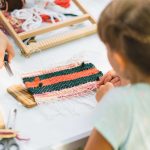
If you find you’re getting stuck, don’t stop sampling. Instead, just make your samples smaller. A single narrow strip of weaving can tell you something useful, or a single line of stitching, or a single small square of dye. If your selvedges are pulling in, check your tension before you alter your structure. If your fabric has a rough finish, check your preparation and washing before you decide it must be the fault of your yarn. Most points of confusion eventually become clear if you just narrow your question a little. Textiles generally reward careful attention more than speed.
Ultimately, your sample collection will become one of your most important tools as you learn how to work with textiles. Being able to handle earlier samples alongside newer ones will allow you to observe your own progress in a very tangible way. You’ll become more articulate about hand, and more discerning about finish. You’ll begin to make decisions based on evidence rather than simple guesswork. If you’re just starting out, that’s an important distinction. It encourages the kind of testing, observation, adjustment, and retesting that’s at the heart of all careful textile practice.